How To: Building a BlueSniper Rifle

How To: Building a BlueSniper Rifle – Part 1

Humphrey Cheung

March 8, 2005 08:00

Introduction

Watching the news these past few weeks, you would think that hackers have taken over our cellphones. From the Paris Hilton phone hack (which was not Bluetooth-based), to the unintentional release of Fred Durst’s (from the band Limp Bizkit) sex video – Wireless security has been thrust into the limelight. The proliferation of Bluetooth devices has made wireless communications easy and the Bluetooth group wants you to believe that this technology is safe from hackers. However, the guys from Flexilis, a wireless think-tank based in Los Angeles, beg to differ and they have a big freakin gun to "voice" their opinions.

The gun, which is called the BlueSniper rifle, can scan and attack Bluetooth devices from more than a mile away. The first version of the gun showed up at Defcon 2004, a hacker/computer security convention held annually in Las Vegas. You can read about it in Tom’s Hardware show coverage report here.

While the early version was held together with tie-straps and rubber bands, this newest version has a much more professional look. The team at Flexilis learned a lot from making their previous gun, and have made many improvements. The gun is now bigger, stronger and more durable and the antenna is almost twice a powerful as the older model. It also has a small computer which eliminates the need for lugging around a heavy laptop just to gather data.

How hard was it to make this gun? John Hering, from Flexilis, says, "The parts are easily available for a few hundred dollars and you can make this gun in a long afternoon." In fact, in this two-part article, we will show you how to build your very own Bluetooth sniper rifle. A complete parts list is provided and we will document each step of the manufacturing process. We’ll also report on our test "shoot" of some famous high-rise buildings in downtown L.A., namely the US Bank / Library Tower and the AON Tower.

Full articale http://www.tomsnetworking.com/2005/03/08/how_to_bluesniper_pt1/index.html


Posted in Computers and Internet | Leave a comment

DIY – LED Mood Lamp

Introduction

After making my pyramid mood light with 12 high power leds, i decided to make a bigger and better version, without the emphasis on the low budget.. After all, the pyramid mood lamp was more of a proof of concept with its shortcomings. I wanted the new mood lamp to be more powerful, so it could also be used in daylight conditions. I did this by using a z-power 3 watt RGB power led. This one led is far more powerful than the 12 ones combined i used before. The colors also mix better because of the wider opening angle and because the rgb chips lay very close together. But you better see it for yourself:


Offcourse a video says more than pictures, so here you can see the different operation modes.

I also was not that satisfied with the diffused look of my previous led lamp in the shape of a pyramid. I had to use sandpaper to transform the transparant plastic casing into a diffused one, but when you look closely you could still see some areas weren’t as diffused as others. And so beginneth my quest for a bigger casing which had to be already diffused…

And i found the perfect housing! Behold: the Mylonit table lamp from Ikea.

They come in two sizes: 31 and 45 cm high. Offcourse i bought the biggest version. Funny thing is Ikea already offers this lamp in different colours. But they all can only light up in one color, the lamp i made can take all colors of the rainbow.

Parts You Need

Here is a list of the components i used for making the led mood lamp.

  • 3 NPN transistors capable of driving 500 mA, for example the BC337
  • one PIC 16F628(A) and a programmer
  • a small perforated circuit board
  • some 1 watt resistors (5, 10 and 15 Ohm) and a DIP switch
  • a power supply (5 volts, 1000 mA)
  • Ikea Mylonit lamp
  • silicon paste from your local DIY shop
  • one z-power 3 watt rgb led
  • a little heatsink and some cooling paste

Because i now use the 3 watt z-power led, i couldn’t use batteries anymore. That’s why i bought a small power supply.

General Layout

Here you see the z-power led mounted on a heatsink i took from an old video card. I drilled two holes and two screws hold the star shaped led in place. To conduct the heat better i used some left over cooling paste that came with my cpu. A smaller heatsink would suffice as well, but i had this heatsink gathering dust in my closet, so…


To avoid a shortcircuit i first dipped the screw heads in some silicon paste and left it to dry. If you take a closer look at the power led, you can see the 3 individual chips for the 3 colors. This led is so bright it’s almost impossible to look directly into it. Then i started building the circuit after calculating the values of the resistors. I changed the calculated values a bit by maxing each color out and looking at the color of white it produced, as i’m not a such a fan of cold, blueish white.I like a warm tone better. This was how my test setup looked like:

The Circuit Board

Once everything was working like i wanted i soldered it all onto a small circuit board.

I cut off one corner to get a better fit in the area under the lamp. This is the schematic i used:

All i needed to do now was pasting it all together to the lamp and soldering the 4 wires from the led to the circuit board.


Programming The PIC 16F628 Microprocessor

I have used most of the code of my pyramid lamp again, but i changed some bits (litterally). Because i now have 4 switches (the one for switching the lamp on and off isn’t used anymore, now i use a power supply) i wanted to add a random function. So you still have the fade and jump to different preprogrammed colors modes, but these modes now also work with random colors calculated on the fly. All of this combined with one switch to choose between two different speeds and another one to pause at any color the lamp is showing that moment.

Conclusion

I am really satisfied with this lamp. This was what i was aiming for when i first got the idea of building my own mood lamp. I think this version definitely deserves the title ‘mood lamp’  because it can light up a whole room with its colors. On the left you can see the lamp still shines strong with other lights on and on the right you can see the effect when all other lights are out. In the back you can see the pyramid lamp i made earlier.

     
Posted in Techie Hobbies | Leave a comment

101 ways to organize your life

Lessons from Project Management: 101 ways to organize your life

Project Management (and life) Wisdom straight from the mouths of the horses – oops, I mean project managers:

Leadership

1. Keep your approach friendly: People are not looking to make friends at work, but refraining from an aggressive approach towards your employees is a good idea. The whip – your – team – into – submission approach worked with the "Pyramids of Giza" project – but it is outdated now. The days when you could bully and scare the s*** out of your team are over. Be diplomatic and assertive, instead.

2. When taking on a new project/responsibility at work, convey to your management the extent of authority you need in order to effectively execute your project. Ensure that you have the authority that you need before you start work on your project.

3. Being people-oriented does not mean that you cannot be task-oriented (and vice-versa).

4. One-to-one: Meet regularly with your team members on a one-on-one basis. When you apply this principle to your kids, it makes each of them feel special.

5. Nobody appreciates a micro-manager: Don’t sit on the heads of your team members.

6. Giving autonomy does not mean not keeping track of progress.

7. Learn how to manage people (more difficult than it sounds, believe you me!), and the rest of your job will that much easier to execute.

8. As a leader, you should have the ability to bind the team together and give them a sense of “we’re in this together.” For instance, as the head of your family, you can promote bonding by setting aside time for family board games, story-telling sessions, family picnics, family prayers and the like.

9. Stay visible – As a leader, you need to be visible in good times, as well as when there are problems to address.

10. Your reputation depends on your perceived credibility and integrity: A very basic item for leaders is to ensure that promises made are promises kept. If action is committed, it must be performed.

11. Personality: As a leader, does your personality influence and inspire your team?

12. Leadership CAN be learned. Focus on these areas to improve your leadership skills:

  • Initiative
  • Leverage your charisma to influence others
  • Lead purposefully and with commitment
  • Develop a result-oriented approach
  • Cultivate an attitude of optimism
  • Work on your self-confidence – especially for weakness areas (for instance, if you are particularly nervous around people with an intimidating body language, create a plan to tackle that, and come across as confident and in-control in their presence.)
  • Cultivate empathy so that you can encourage and nurture your team
  • Learn to identify winners – and nurture them
  • Learn to read between the lines to understand the underlying concern that prompted the dialogue
  • The ability to motivate people so that they stretch out of their "comfort zones"
  • Improve your decision-making abilities by learning from past decisions
  • Learn to see the big picture
  • Polish your Goal Setting skills
  • Develop Personal Goals and examine them at regular intervals
  • Effective Time Management

13. Flexibility: While it is a good thing to be firm and stand by your decisions, It is important that you are flexible enough to realize when plans need to change. View planning as an ongoing process. That way, you can change course midway without too much damage, if the original plan is not working. Are you open to continuous planning and updating of the plan?

Effective personnel management (Managing your team / family unit)

14. Stand up for your team. When your employees are in the right, have the guts to take up their case.

15. Don’t let team members intimidate you with technical mumbo-jumbo. Don’t feel stupid when you ask them to explain what they are saying in layperson’s language.

16. Match assignments with skill sets: Is every team member equipped to handle his part of the assignment? If not, then you are in deep trouble!

17. Creative Solutions: A Japanese story – when a little girl kept wearing the wrong shoe on the wrong foot, her parents found a solution. There was half a smiley face on either shoe. The smiley face was complete only when she wore her shoes the correct way. Problem solved. It can be as simple as that if we use our creativity.

18. When you pressure your team to deliver faster than is humanly possible, don’t be surprised to see a poor quality, bug-laden product.

19. Agree on rules: In project management, once the design has been completed, the design and production staff create a style guide for future reference. Make the rules of the game clear to all players involved, and to any players who join in later on.

20. Building Trust: Build trust within the team by demonstrating to each team member that everyone is important and creating a sense of personal value and contribution.

21. According to the book "Retaining Your Best People" (Harvard Business School Press), retention should become a core strategy. A very significant and important piece of advice from the book and something that all leaders should do on a regular basis is to "let your best people know you treasure them, count on them, and want to reward them in as many ways as possible."

22. Look beyond money: There should be an effort by the manager, project manager, or business executive to determine what the non-monetary interests of the key players are. Translated to a family situation, don’t sit smug thinking that you are doing your bit by bringing in the bacon. Your family needs more than that from you – your attention and interest, for instance.

23. Say thanks, offer words of support, and show appreciation for good work.

24. Reward your key players as often as possible. People generally won’t work for people who just don’t care for them.

25. Provide Challenges – Encourage your team to stretch beyond their comfort zone. This will help them see just how far they can go.

Recognition

26. Rewarding works better than nagging: A reward can be something as simple as a coin or a note of appreciation – as long as your employees perceive it as a symbol of recognition, it works.

The relationship between Accountability, Empowerment, Ownership and Motivation

27. The buck stops here: You are accountable for your task / project. However, this does not mean that you do not delegate. Delegate work to your team members, let them know that they are accountable for their assignment/s, and ensure that they have the resources so that they can deliver successfully. Decide the plan of action beforehand, and decide how follow-ups will happen.

28. Ownership: Have an attitude of owning your work.

29. Minimize your supervision – Provide a sense of autonomy. Freedom is a major motivator and builds trust on both sides. (Tip: But don’t tune out completely.)

30. To motivate, you have to empower. Motivation involves not only being enthusiastic and pumped up about approaching the task, but also involves being equipped with the tools and the ability to complete the assignment. When you delegate an assignment, convey to the team member that it is now THEIR exclusive responsibility that the job gets done. If it doesn’t, they will be held accountable.

31. Accountability of Self: Take a couple of co-workers into confidence about your expectations from yourself. Besides making your goals clearer to yourself, this helps others keep track of your progress.

Communication

32. Clear, open communication is a prerequisite for a healthy, result-oriented work environment.

33. Keep them posted: A lack of information is a fertile ground for rumor, gossip and insecurity. Keep the team in the loop about information concerning and affecting them.

34. When in doubt, ask: Don’t refrain from asking “stupid” questions – they may save miscommunication and misunderstandings, resulting in saved time and money!

35. It is bad policy to wait till your team members find out important information concerning them from other sources. That information should come from you.

36. Ask questions and listen to suggestions.

37. Feedback: Provide it often and ask for it. Keep an open mind. (Tip: Don’t expect all feedback to be pleasant and positive.)

38. Listen: It’s always important to listen, but even more so in tough times. Listen for undertones.

39. Be Open: While you should not be a dumping ground for grievances, you SHOULD be accessible enough for team members to openly discuss concerns or delays. (Tip: If you are not open, you’ll find out about the concern or delay later in the game when there is less time to fix it.)

40. Touch Base: One-on-one and in meetings, meet up with your team members (or family members). (Sitting in front of the television with the family does not count as touching base!)

Morale

41. Pride: Have you read the Japanese story about the janitor who described his work as “Contributing to the progress of his country?” His logic – if the executives did not have clean toilets to use, they couldn’t be very productive, could they? That is the kind of pride you need to have in your work / project.

42. Keep your sense of humor: It helps – especially in situations where no one feels like laughing. (Like the time a short executive stood on a chair so that she was at eye-level with her colleague, and she quipped, “Maybe now we can see eye-to eye?” The laughter that followed this lightened up the tension that everyone in the room had been feeling up to that point.)

43. Have fun @ work: It’s true that all work and no play makes Jack a dull b ec638dcoy. And fun, on the other hand, recharges your batteries and lets you approach work with a fresh mind.

44. Celebrate achievements – even mini-achievements: Celebrating at every landmark gives your team something to look forward to, and lets them remember that they are making steady progress towards their goal – project completion!

45. Give praise: When a team member does something great, let them know it! Make sure your praise is sincere. Also, your praise will be valued only if it is given when it’s due.

46. Help Others Help Themselves: If a team member / family member has a mental block, you can guide this individual to tear it down. (Tip: Tackle such issues early on, because a negative frame of mind can be highly infectious.)

Self-Management

47. Use impatience to your advantage: Channel the energies generated by your impatience to propel the process faster.

48. Procrastinators don’t make good project managers. Find a way around your weakness (procrastination) if you want to achieve your targets.

49.

24X7 availability for the project is not the way to effective achievement of targets. It will only end up overwhelming you. “The key is to schedule and set boundaries so you don’t need to be accessible 24/7.” (webmonkey)

50. Do you like what you are doing? If not, why are you still doing it? Money is not compensation enough for being trapped in a role you do not like. Because for every hour you spend doing something you don’t enjoy, you are giving up doing something that you do.

51. Be Informed: Know not only what is happening in your organization, but also keep track of changes within other organizations that may impact your team members.

52. Analyze after the event: A postmortem offers valuable insights for future reference.

53. Ask yourself
    (1) Do I know what is expected of me?
    (2) Do I expect I can perform that which is expected of me?
    (3) Do I expect a reward of value to me personally?

Stress

54. Use stress as an ally: Let stress work as the red flag that tells you to take action.

55. One key element in dealing with stress is taking control. A feeling of helplessness increases stress. So take some action that reflects that you do retain some amount of control over the situation – even if that little control is only over your reaction to the stressor.

Personal organization

56. Nothing beats being organized. Keep an organized filing system, for instance, even something as simple as storing documents chronologically will go a long way in saving you time and stress when you need to locate information.

57. Keep a daily journal where you jot down the day’s highlights. Then, set aside an hour on Saturday night/evening to analyze your week. What did you do wrong? What did you do right? What will you do differently the next time in a similar situation? This practice will help you grow professionally and personally in the long run.

58. Make daily lists and cross things off. Keep a personal scorecard and grade yourself weekly.

59. Buy a Daily Planner; now actually use it.

Planning

60. Plan ahead: Before you plunge headlong into work, spend some time planning your project.

61. Break down work into tasks: Breaking down the project into smaller tasks (and mini-tasks if required) ensures that you have a systematic approach.

62. Keep it visible and visual: Plotting a chart or graph about work progress and tacking it in a prominent place on your soft board (or keeping the softcopy on your desktop) ensures that your progress is visible to you.

63. Infrastructure: A reliable server lays the foundation for efficient work. Good infrastructure and equipment translate to smooth functioning for any task.

64. A step-by-step plan is the best way to ensure you know where you are going.

65. In project management, the bulk of the work happens after the planning phase. How well this implementation of the plan happens depends on how thorough and specific the planning and documentation was. Bad planning translates to bad implementation.

66. Good planning alone does not ensure good implementation. Follow-through becomes vital here. As the leader, the project manager ensures that the team sticks to the plan.

67. As a project manager, you need to check that everyone is following the functional spec and style guide, that they are using the proper naming conventions and version controls, and that backup files are being saved on the server. Rules are useful only insofar as they are implemented and followed.

68. Be prepared: Know your stuff front-wards, back-wards, and every way in between. This does not mean that you need to say everything you know. Being prepared helps you to quickly answer questions and convey that you know what you are talking about.

69. Understanding the goals: A project is truly successful only when you are meeting the need for which it was created. Identifying the scope and requirements at the outset and also acknowledging that in the real world, these can change is a good starting point.

70. Getting it right from the outset: The most important part of a project’s life cycle is the identification of its requirements.

Conflicts

71. Manage conflict (especially within the team) at an early stage – before it reaches crisis proportions.

72. The best way to side-step petty politics – nip conflicts in the bud.

73. Remember that no two people view the situation with the same pair of eyes – they actually see different things. This helps in understanding differences of viewpoints and eventually resolving conflict within your team.

74. Create the Team Charter; and keep it up-to-date: A team charter is a code of conduct developed by the project management team and later adopted or modified by the project team. It defines the mutual expectations of each team member of one another. As a project manager, hold yourself and others accountable to be consistent with this code.

Risk Management

75. There is no such thing as a zero-risk project: There is no such thing as a risk-free life.

76. If you want to understand a risk fully, identify its causes as well as its effects.

77. How do you respond to risks? There are four ways:
    a) Aggressive responses: You can achieve avoidance by removing or changing a cause, or by breaking the cause-risk link so that the threat is no longer possible.
    b) Third party: You involve a third party to manage the risk.
    c) Size: You can change the size of a risk, thus reducing a threat.
    d) Acceptance: You accept the possibility  of the risk, and create a fallback plan to recover from negative impacts.

78. When a project is desperately troubled, first take action to contain the damage then worry about recovery, just the way a first aid or rescue teams first “contain the damage” and consider other options after the victim’s condition stabilizes.

79. Checklists for risks: Trouble sometimes stems from omissions. It is easy to “forget” key components of a work package. A checklist reduces the potential of leaving out important considerations.

Work / Life Balance

Naps, Breaks and Vacations: The rejuvenation trio

80. Take a break: When you feel overwhelmed, take a break; get your mind off work for some time. Chances are, you will be able to handle the situation better after a break.

81. Get enough sleep: There is no substitute for sleep. All else being equal, a well-rested person is better equipped to meet the challenges that the day presents, as compared to a person who has not had enough rest.

82. When you plan a vacation and want to really enjoy it, ensure that all the work-oriented nitty gritty is taken care of, and out of the way.

83. Manage your vacation as a project (a lot of planning) if you enjoy doing a lot of things rather than just lying around idly all day (which is also an excellent way to recharge your batteries, by the way).

What You Eat

84. Remember GIGO? Garbage in, Garbage out: Eat low-energy fast food and be prepared for irritability, mood swings, and blood sugar swings. Eat healthy, wholesome and nutritious meals to bring out the best in you.

Bonding and Loving

85. A healthy personal life translates to a well-balanced, healthy person. Make sure you are not succeeding at the workplace at the cost of your family and loved ones. Given enough time, they will learn to live without you around – without complaining about it. Tip: Pets are wonderful to shower you with (unconditional) love when nobody else will.

86. No job in the world is worth neglecting your kids for. Your kids will outgrow their strong dependence on you – the job will always be there (one or the other). If you are not there for them when they need you the most, don’t count on their unconditional acceptance and love for you later on.

Your clients and stakeholders

87. Keep the stakeholders updated: Keep the sponsors and stakeholders posted about the progress. This becomes more important when there are unforeseen problems or newer risks; like when there are delays.

88. Understand the need: When working on the project, it helps if you understand what need your project will fulfill. Sometimes (make that often) your client’s description the project will not match his need. Ensure that what you are doing will serve the purpose that it is meant to serve.

89. When to give in and when to hold your ground: Once a project has started, the client will almost always want you to incorporate changes and add tasks. Sometimes requests are legitimate, and it is possible to incorporate them without throwing the project off track. But when the client’s demands require significant changes, you need to take a call. Michelangelo Buonarroti’s ceiling of the Sistine chapel project is a classic case in point. The original project involved creating twelve paintings. By the time the project was completed, over 300 paintings had been created, costing the artist his health and youth.

90. When stakeholders do not respond to information or do not respond in an expected manner; create alternative, proactive communication mechanisms to avert trouble.

91. Don’t forget to ask, “What does my client want to be able to do as a result of this project?” Translated to real life situations, every time you work on something, ask yourself what you (or someone else) hope to accomplish from that activity. The answer can be as simple as “feeling refreshed and rejuvenated” to something as complex as “moving towards my dream of contributing to a cleaner and healthier planet”.

Across Borders – It’s a global world!

92.

Whether working with offshore teams or just a diverse group at home, today’s project environment is multicultural. Be open to and aware of your project stakeholders’ cultures. Not only should we respect our colleagues’ cultures, but we should understand and EXPERIENCE them. Go out for Dim sum with the team or learn a new phrase in another language. (allpm.com)

93. Cross-cultural global relations: (courtesy Elizabeth Larson, PMP and Richard Larson, PMP)
    a) Plan extra time to model requirements when working cross-culturally.
While modeling is an excellent tool for overcoming some cross-cultural communication issues, multi-cultural project management may still take extra time to get the requirements and ensure that important facts are captured.
    b) It is important to plann more time for capturing requirements when working in multi-cultural environments.
    c) Meeting in Person to Develop Relationships Saves Time and Money in the Long Run. In some cultures tasks are completed based on established relationships and, ultimately, trust, rather than simply being driven by schedules. Attempting to forge ahead with tasks before spending social time with clients can well lead to incomplete requirements. While it may not be standard practice all over the world, when PMs are working in some other cultures taking the time to meet face-to-face can save time and money for your project and organization.

The Zen of Project Management – George Pitagorsky’s tips

94. Zen is a form of self-investigation that has its roots in China and Japan.  It is a merging of Indian Buddhism and Taoism.  The Zen approach is one that cuts through complexity to go straight to the heart of a matter.  Zen promotes knowing through inner experience.  It promotes discipline from within.  In the Zen way, the individual comes to fully know his or her own nature by cutting through intellectualism, cultural barriers, conditioned responses, rules and any other “extras” that get in the way of seeing the essence.  One who sees the essential nature of things has wisdom.  Wisdom leads naturally to compassion.  Wisdom and compassion are at the heart of our essential nature.

95. What is a wise approach? It is an approach that gives us the ability to see things clearly and minimize the probability that we will be reactive and ineffective in achieving our goals and objectives.  Wisdom is the synthesis of knowledge into active, practical use.  A wise person moves through life with equanimity, un-phased by the chaos surrounding her.  A wise person has choices.  He is not unconsciously driven and reactive.

96. "Only the person who learns to relax is able to create, and for them, ideas reach the mind like lightning." Even in face of chaos, pressure and stress, relax! How? Relaxation is not the same as tuning out and turning off. It is not somnabulence. Learn to rest in the moment. Cultivate the ability to quickly focus on your breath and body just long enough to find your "center". Then engage.

97. Serve someone. Serve everyone. That is the secret of wise leadership. There is a difference between a leader who serves and one who just leads. "The difference manifests itself in the care taken by the servant-first to make sure that other people’s highest priority needs are being served." Such a leader asks if "those served grow as persons; do they, while being served, become healthier, wiser, freer, more autonomous, more likely themselves to become servants?" When the motivation is to serve, posturing, politics and self-serving gains are replaced by useful effective action.

98. Mental models are deeply ingrained assumptions, generalizations … that influence how we understand the world and how we take action. ” They may be useful, or they may lead to habitual, reactive behavior. What paradigms condition your behavior? Do they help or hinder you? Do you have the courage to question them? Do they provide established basis for analyzing problems, or do they limit your ability to act in the way that is best for the current situation.

99. Desiring the impossible gives rise to suffering It is also the root of many failed projects. When undertaking a project, you have the duty to question authority, to push back. Ask questions, rather than voice objections. Why is this the deadline? What if it isn’t met? What do you really need, and by when? What assumptions are you making? What would you give up to get what what you really need? Will we have the right resources at the right time?

100. The Good, The Bad, The Continuous Improvement: We learn at least as much from bad experience as we do from good. Yet, blaming, fear of punishment and models like “I’m so smart, how can I make mistakes” lead us to avoid looking at and learning from our mistakes. Continuous improvement begins with the candid acceptance of the existing situation, particularly its flaws. If you don’t accept what is, you can’t change it.

101. How to Push Back when Negotiating: When pushing back to negotiate a rational schedule and budget you need solid footing. Come to the table with a well articulated plan, complete with assumptions. Use your communication, task definition, estimating, scheduling, and risk management skills and knowledge to offer realistic alternatives. Seek win-win solutions. What if you are forced to accept an irrational schedule or budget? Try to do your best to negotiate expectations that can be met given the project’s scope, resources, and risks. Do your best to work within the project’s real-world conditions.

Posted in Social | Leave a comment

Bump Keying….. and you though locks were safe

Posted in Hobbies | Leave a comment

Bandwidth Monitoring Tools

Bandwidth Monitoring Tools

I did a lot of research about bandwidth monitoring tools recently.

Yesterday, I wrote about ibmonitor and bandwidthd in Bandwidth Monitoring blog. Today I just would like to share another great bandwidth monitoring tools.

Note: The installation guide below running either with RHEL3/4 and FC4.

A. tcptrack is a sniffer which displays information about TCP connections it sees on a network interface. It passively watches for connections on the network interface, keeps track of their state and displays a list of connections in a manner similar to the unix ‘top’ command. It displays source and destination addresses and ports, connection state, idle time, and bandwidth usage.


[root@planetmy download]#wget
http://www.rhythm.cx/~steve/devel/tcptrack/release/1.1.5/source/tcptrack-1.1.5.tar.gz
[root@planetmy download]#tar xvfz tcptrack-1.1.5.tar.gz
[root@planetmy download]#cd tcptrack-1.1.5
[root@planetmy tcptrack-1.1.5]#./configure
[root@planetmy tcptrack-1.1.5]#make
[root@planetmy tcptrack-1.1.5]#make install
#(I skip this step)
[root@planetmy tcptrack-1.1.5]#cd src

[root@planetmy tcptrack-1.1.5]#./tcptrack -i eth0
[root@planetmy tcptrack-1.1.5]#./tcptrack -i eth0 port 443
[root@planetmy tcptrack-1.1.5]#
./tcptrack -i eth0 src 10.10.10.1
[root@planetmy tcptrack-1.1.5]#
./tcptrack -i eth0 dst 10.10.10.1

Result:

B. pktstat display a real-time list of active connections seen on a network interface, and how much bandwidth is being used by what. Partially decodes HTTP and FTP protocols to show what filename is being transferred. X11 application names are also shown. Entries hang around on the screen for a few seconds so you can see what just happened. Also accepts filter expressions á la tcpdump.


[root@planetmy download]#wget
http://www.adaptive-enterprises.com.au/~d/software/pktstat/pktstat-1.8.1.tar.gz
[root@planetmy download]#tar xvfz pktstat-1.8.1.tar.gz
[root@planetmy download]#cd pktstat-1.8.1
[root@planetmy pktstat-1.8.1]#./configure
[root@planetmy pktstat-1.8.1]#make
[root@planetmy pktstat-1.8.1]#make install
#(I skip this step)

[root@planetmy pktstat-1.8.1]#./pktstat
[root@planetmy pktstat-1.8.1]#./pktstat -i eth0
[root@planetmy pktstat-1.8.1]#./pktstat --help

Result:

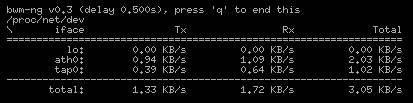
C. bwm-ng – Bandwidth Monitor NG is a small and simple console-based live bandwidth monitor for Linux, BSD, Solaris, Mac OS X and others.


[root@planetmy download]#wget
http://www.gropp.org/bwm-ng/bwm-ng-0.5.tar.gz
[root@planetmy download]#tar xvfz bwm-ng-0.5.tar.gz
[root@planetmy download]#cd bwm-ng-0.5
[root@planetmy bwm-ng-0.5]#./configure
[root@planetmy bwm-ng-0.5]#make
[root@planetmy bwm-ng-0.5]#make install
#(I skip this step)

[root@planetmy bwm-ng-0.5]#cd src
[root@planetmy bwm-ng-0.5]#./bwm-ng -a
[root@planetmy bwm-ng-0.5]#./bwm-ng --help

D. iftop display bandwidth usage on an interface. iftop does for network usage what top(1) does for CPU usage. It listens to network traffic on a named interface and displays a table of current bandwidth usage by pairs of hosts.


[root@planetmy download]#wget
http://www.ex-parrot.com/~pdw/iftop/download/iftop-0.17.tar.gz
[root@planetmy download]#tar xvfz iftop-0.17.tar.gz
[root@planetmy download]#cd iftop-0.17
[root@planetmy iftop-0.17]#./configure
[root@planetmy iftop-0.17]#make
[root@planetmy iftop-0.17]#make install
#(I skip this step)

[root@planetmy iftop-0.17]#./iftop -B -P -i eth0
[root@planetmy iftop-0.17]#./iftop --help

E. Speedmeter monitor network traffic or speed/progress of a file transfer.


Download and install Urwid (recommended)
[root@planetmy download]#wget
http://excess.org/urwid/urwid-0.9.5.tar.gz
[root@planetmy download]#tar xvfz urwid-0.9.5.tar.gz
[root@planetmy download]#cd urwid-0.9.5
[root@planetmy urwid-0.9.5]#python setup.py install

[root@planetmy download]#wget
http://excess.org/speedometer/speedometer.py
[root@planetmy download]#
cp speedometer.py /usr/local/bin/speedometer
[root@planetmy download]#cd /usr/local/bin
[root@planetmy bin]#chown root: speedometer
[root@planetmy bin]#chmod 755 speedometer

[root@planetmy download]#cd /usr/local/bin
[root@planetmy bin]#./speedometer.py -rx eth0 -tx eth0
[root@planetmy bin]#./speedometer.py --help

F. CBM the color bandwidth meter. CBM is a small program to display the traffic currently flowing through your network devices.


you may require xmlto for cbm to work
[root@planetmy download]#wget
http://cyberelk.net/tim/data/xmlto/stable/xmlto-0.0.18.tar.bz2
[root@planetmy download]#tar xvfj xmlto-0.0.18.tar.bz2
[root@planetmy download]#cd xmlto-0.0.18
[root@planetmy xmlto-0.0.18]#./configure
[root@planetmy xmlto-0.0.18]#make
[root@planetmy xmlto-0.0.18]#make install

[root@planetmy download]#wget
http://www.isotton.com/utils/cbm/download/cbm-0.1.tar.gz
[root@planetmy download]#tar xvfz cbm-0.1.tar.gz
[root@planetmy download]#cd cbm-0.1
[root@planetmy cbm-0.1]#./configure
[root@planetmy cbm-0.1]#make
[root@planetmy cbm-0.1]#make install

[root@planetmy cbm-0.1]#/usr/local/bin/cbm

Enjoy and hope this is useful!

Posted in Computers and Internet | Leave a comment

Wireless LCD in 5 minutes!


Wireless LCD in 5 minutes!

Today, I was thinking how dirty and full of stuff my desk was.  So I
decided to relocate my graphic LCD to another person’s desk but still
have control over it.  To do this, I figured I could simply use the
ACODE-300 wireless bluetooth modules.


Required Parts ;

2 ACODE-300 Bluetooth modules
1 ACODE Interface Board
2 LEDs
1 LM3940 or any 5-to-3.3v regulator
1 15K and 30K resistors
1 GHLCD graphic LCD (or any serial LCD)
6 4-pin sockets (or simply cut a 16-pin socket like me~)
1 CUBLOC or some type of microcontroller


[Larger Image Download]

You can connect your devices as shown in the above schematic.

(Make sure to use sockets for the ACODE-300 modules, so you can
plug and un-plug the modules for setup)

When you are done making the above, you will ultimately end up with the below:


(Study Board & ACODE300)


(ACODE-300 Proto board for Study Board Close-up)


(front of GHLCD)


(back of GHLCD w/ my ACODE-300 Proto board installed)


(My ACODE-300 Proto board for graphic LCD Close-up)


(Connections to TTL Outputs of GHLCD & Baud rate set to 115200)

The ACODE-300 Bluetooth modules are very easy to use and can be
applied to any serial RS232 interface.  You can make a wireless
applications such as this one or any other wired app into a wireless app.

When you are done making your proto-boards and connections,
you are ready for testing.

Insert your ACODE-300 module from your study board as shown
above to the interface board.  Also connect a serial cable and
DC power (between 5 and 12V) to the interface board.

Run the PromiWIN4.0_Setup(En).exe installer program and install
Promi software, which we will use to link the two ACODE-300 wireless modules.

      PromiWIN4.0_Setup(En).exe Download

The default baud rate for ACODE-300 is set at 9600 bps.  So Just
click OK, and you should be able to see the following screen:

Now we are ready to set the device to a faster baud rate.

Change the Operation Mode to MODE3, Baud rate to 115200bps and
set the device name to "device 1" as shown above.

If you get the message "Configuration has been applied," you are ready to go.
Unplug your ACODE-300 module from the interface board and plug it back into your study board.

Power ON your study board and your ACODE-300 should start
blinking the LED like above every 1-2 seconds.

Now take your ACODE-300 module from your GHLCD graphic LCD and
plug it into the interface board and run Promi program again.

Once you are connected, change the Operation Mode to MODE1, Baud
rate to 115200bps and set the device name to "device 1" as shown above.

After applying the above settings, Click on "Connection(out)" and press "Search".

You should be able to find the "device 1", the ACODE-300 module on the study board. 

Now, select the "device 1" and click on "Connect".

You should see both LEDs of ACODE-300 turn on continusly once
you get this message:


(LEDs continuously ON)

When LEDs are lit up like above, the ACODE-300 modules are
connected and a straight RS232 serial connection has been
established.  It’s as if a serial cable has been connected
wirelessly.

Now unplug the ACODE-300 module from the interface board and
plug it back into your GHLCD LCD module.

Now when you power ON both study board and the GHLCD graphic
LCD, you should see both LEDs light ON as shown in above picture.

Now open up your CUBLOC Studio and compile and run the tetris
demo program which simply send RS232 LCD commands.


(Open CublocStudio, and download Tetris program)

Tetris Program Download

When you are done downloading to CUBLOC, you should see a tetris
program running wireless!


(wireless LCD finished)

This wireless LCD should work up to around 100 feet flawlessly.
Now, I can have my graphic LCD sitting at another person’s desk
and clean some of the clutter off my own desk.


Now I challenge you to make some other wireless app whether you
are using CUBLOC or any other microcontroller.
 

If you are having any trouble with above app, please e-mail max@comfiletech.com

If you have any cool apps you’d like to share, please e-mail to max@comfiletech.com


Posted in Computers and Internet | Leave a comment

As the Arabs see the Jews


"As the Arabs see the Jews"
His Majesty King Abdullah,
The American Magazine

November, 1947


Summary

This fascinating essay, written by King Hussein’s grandfather King Abdullah, appeared in the United States six months before the 1948 Arab-Israeli War. In the article, King Abdullah disputes the mistaken view that Arab opposition to Zionism (and later the state of Israel) is because of longstanding religious or ethnic hatred. He notes that Jews and Muslims enjoyed a long history of peaceful coexistence in the Middle East, and that Jews have historically suffered far more at the hands of Christian Europe. Pointing to the tragedy of the holocaust that Jews suffered during World War II, the monarch asks why America and Europe are refusing to accept more than a token handful of Jewish immigrants and refugees. It is unfair, he argues, to make Palestine, which is innocent of anti-Semitism, pay for the crimes of Europe. King Abdullah also asks how Jews can claim a historic right to Palestine, when Arabs have been the overwhelming majority there for nearly 1300 uninterrupted years? The essay ends on an ominous note, warning of dire consequences if a peaceful solution cannot be found to protect the rights of the indigenous Arabs of Palestine.


"As the Arabs see the Jews"
His Majesty King Abdullah,
The American Magazine

November, 1947

I am especially delighted to address an American audience, for the tragic problem of Palestine will never be solved without American understanding, American sympathy, American support.

So many billions of words have been written about Palestine—perhaps more than on any other subject in history—that I hesitate to add to them. Yet I am compelled to do so, for I am reluctantly convinced that the world in general, and America in particular, knows almost nothing of the true case for the Arabs.

We Arabs follow, perhaps far more than you think, the press of America. We are frankly disturbed to find that for every word printed on the Arab side, a thousand are printed on the Zionist side.

There are many reasons for this. You have many millions of Jewish citizens interested in this question. They are highly vocal and wise in the ways of publicity. There are few Arab citizens in America, and we are as yet unskilled in the technique of modern propaganda.

The results have been alarming for us. In your press we see a horrible caricature and are told it is our true portrait. In all justice, we cannot let this pass by default.

Our case is quite simple: For nearly 2,000 years Palestine has been almost 100 per cent Arab. It is still preponderantly Arab today, in spite of enormous Jewish immigration. But if this immigration continues we shall soon be outnumbered—a minority in our home.

Palestine is a small and very poor country, about the size of your state of Vermont. Its Arab population is only about 1,200,000. Already we have had forced on us, against our will, some 600,000 Zionist Jews. We are threatened with many hundreds of thousands more.

Our position is so simple and natural that we are amazed it should even be questioned. It is exactly the same position you in America take in regard to the unhappy European Jews. You are sorry for them, but you do not want them in your country.

We do not want them in ours, either. Not because they are Jews, but because they are foreigners. We would not want hundreds of thousands of foreigners in our country, be they Englishmen or Norwegians or Brazilians or whatever.

Think for a moment: In the last 25 years we have had one third of our entire population forced upon us. In America that would be the equivalent of 45,000,000 complete strangers admitted to your country, over your violent protest, since 1921. How would you have reacted to that?

Because of our perfectly natural dislike of being overwhelmed in our own homeland, we are called blind nationalists and heartless anti-Semites. This charge would be ludicrous were it not so dangerous.

No people on earth have been less "anti-Semitic" than the Arabs. The persecution of the Jews has been confined almost entirely to the Christian nations of the West. Jews, themselves, will admit that never since the Great Dispersion did Jews develop so freely and reach such importance as in Spain when it was an Arab possession. With very minor exceptions, Jews have lived for many centuries in the Middle East, in complete peace and friendliness with their Arab neighbours.

Damascus, Baghdad, Beirut and other Arab centres have always contained large and prosperous Jewish colonies. Until the Zionist invasion of Palestine began, these Jews received the most generous treatment—far, far better than in Christian Europe. Now, unhappily, for the first time in history, these Jews are beginning to feel the effects of Arab resistance to the Zionist assault. Most of them are as anxious as Arabs to stop it. Most of these Jews who have found happy homes among us resent, as we do, the coming of these strangers.

I was puzzled for a long time about the odd belief which apparently persists in America that Palestine has somehow "always been a Jewish land." Recently an American I talked to cleared up this mystery. He pointed out that the only things most Americans know about Palestine are what they read in the Bible. It was a Jewish land in those days, they reason, and they assume it has always remained so.

Nothing could be farther from the truth. It is absurd to reach so far back into the mists of history to argue about who should have Palestine today, and I apologise for it. Yet the Jews do this, and I must reply to their "historic claim." I wonder if the world has ever seen a stranger sight than a group of people seriously pretending to claim a land because their ancestors lived there some 2,000 years ago!

If you suggest that I am biased, I invite you to read any sound history of the period and verify the facts.

Such fragmentary records as we have indicate that the Jews were wandering nomads from Iraq who moved to southern Turkey, came south to Palestine, stayed there a short time, and then passed to Egypt, where they remained about 400 years. About 1300 BC (according to your calendar) they left Egypt and gradually conquered most—but not all—of the inhabitants of Palestine.

It is significant that the Philistines—not the Jews—gave their name to the country: "Palestine" is merely the Greek form of "Philistia."

Only once, during the empire of David and Solomon, did the Jews ever control nearly—but not all—the land which is today Palestine. This empire lasted only 70 years, ending in 926 BC. Only 250 years later the Kingdom of Judah had shrunk to a small province around Jerusalem, barely a quarter of modern Palestine.

In 63 BC the Jews were conquered by Roman Pompey, and never again had even the vestige of independence. The Roman Emperor Hadrian finally wiped them out about 135 AD. He utterly destroyed Jerusalem, rebuilt under another name, and for hundreds of years no Jew was permitted to enter it. A handful of Jews remained in Palestine but the vast majority were killed or scattered to other countries, in the Diaspora, or the Great Dispersion. From that time Palestine ceased to be a Jewish country, in any conceivable sense.

This was 1,815 years ago, and yet the Jews solemnly pretend they still own Palestine! If such fantasy were allowed, how the map of the world would dance about!

Italians might claim England, which the Romans held so long. England might claim France, "homeland" of the conquering Normans. And the French Normans might claim Norway, where their ancestors originated. And incidentally, we Arabs might claim Spain, which we held for 700 years.

Many Mexicans might claim Spain, "homeland" of their forefathers. They might even claim Texas, which was Mexican until 100 years ago. And suppose the American Indians claimed the "homeland" of which they were the sole, native, and ancient occupants until only some 450 years ago!

I am not being facetious. All these claims are just as valid—or just as fantastic—as the Jewish "historic connection" with Palestine. Most are more valid.

In any event, the great Moslem expansion about 650 AD finally settled things. It dominated Palestine completely. From that day on, Palestine was solidly Arabic in population, language, and religion. When British armies entered the country during the last war, they found 500,000 Arabs and only 65,000 Jews.

If solid, uninterrupted Arab occupation for nearly 1,300 years does not make a country "Arab", what does?

The Jews say, and rightly, that Palestine is the home of their religion. It is likewise the birthplace of Christianity, but would any Christian nation claim it on that account? In passing, let me say that the Christian Arabs—and there are many hundreds of thousands of them in the Arab World—are in absolute agreement with all other Arabs in opposing the Zionist invasion of Palestine.

May I also point out that Jerusalem is, after Mecca and Medina, the holiest place in Islam. In fact, in the early days of our religion, Moslems prayed toward Jerusalem instead of Mecca.

The Jewish "religious claim" to Palestine is as absurd as the "historic claim." The Holy Places, sacred to three great religions, must be open to all, the monopoly of none. Let us not confuse religion and politics.

We are told that we are inhumane and heartless because do not accept with open arms the perhaps 200,000 Jews in Europe who suffered so frightfully under Nazi cruelty, and who even now—almost three years after war’s end—still languish in cold, depressing camps.

Let me underline several facts. The unimaginable persecution of the Jews was not done by the Arabs: it was done by a Christian nation in the West. The war which ruined Europe and made it almost impossible for these Jews to rehabilitate themselves was fought by the Christian nations of the West. The rich and empty portions of the earth belong, not to the Arabs, but to the Christian nations of the West.

And yet, to ease their consciences, these Christian nations of the West are asking Palestine—a poor and tiny Moslem country of the East—to accept the entire burden. "We have hurt these people terribly," cries the West to the East. "Won’t you please take care of them for us?"

We find neither logic nor justice in this. Are we therefore "cruel and heartless nationalists"?

We are a generous people: we are proud that "Arab hospitality" is a phrase famous throughout the world. We are a humane people: no one was shocked more than we by the Hitlerite terror. No one pities the present plight of the desperate European Jews more than we.

But we say that Palestine has already sheltered 600,000 refugees. We believe that is enough to expect of us—even too much. We believe it is now the turn of the rest of the world to accept some of them.

I will be entirely frank with you. There is one thing the Arab world simply cannot understand. Of all the nations of the earth, America is most insistent that something be done for these suffering Jews of Europe. This feeling does credit to the humanity for which America is famous, and to that glorious inscription on your Statue of Liberty.

And yet this same America—the richest, greatest, most powerful nation the world has ever known—refuses to accept more than a token handful of these same Jews herself!

I hope you will not think I am being bitter about this. I have tried hard to understand that mysterious paradox, and I confess I cannot. Nor can any other Arab.

Perhaps you have been informed that "the Jews in Europe want to go to no other place except Palestine."

This myth is one of the greatest propaganda triumphs of the Jewish Agency for Palestine, the organisation which promotes with fanatic zeal the emigration to Palestine. It is a subtle half-truth, thus doubly dangerous.

The astounding truth is that nobody on earth really knows where these unfortunate Jews really want to go!

You would think that in so grave a problem, the American, British, and other authorities responsible for the European Jews would have made a very careful survey, probably by vote, to find out where each Jew actually wants to go. Amazingly enough this has never been done! The Jewish Agency has prevented it.

Some time ago the American Military Governor in Germany was asked at a press conference how he was so certain that all Jews there wanted to go to Palestine. His answer was simple: "My Jewish advisors tell me so." He admitted no poll had ever been made. Preparations were indeed begun for one, but the Jewish Agency stepped in to stop it.

The truth is that the Jews in German camps are now subjected to a Zionist pressure campaign which learned much from the Nazi terror. It is dangerous for a Jew to say that he would rather go to some other country, not Palestine. Such dissenters have been severely beaten, and worse.

Not long ago, in Palestine, nearly 1,000 Austrian Jews informed the international refugee organisation that they would like to go back to Austria, and plans were made to repatriate them.

The Jewish Agency heard of this, and exerted enough political pressure to stop it. It would be bad propaganda for Zionism if Jews began leaving Palestine. The nearly 1,000 Austrian are still there, against their will.

The fact is that most of the European Jews are Western in culture and outlook, entirely urban in experience and habits. They cannot really have their hearts set on becoming pioneers in the barren, arid, cramped land which is Palestine.

One thing, however, is undoubtedly true. As matters stand now, most refugee Jews in Europe would, indeed, vote for Palestine, simply because they know no other country will have them.

If you or I were given a choice between a near-prison camp for the rest of our lives—or Palestine—we would both choose Palestine, too.

But open up any other alternative to them—give them any other choice, and see what happens!

No poll, however, will be worth anything unless the nations of the earth are willing to open their doors—just a little—to the Jews. In other words, if in such a poll a Jew says he wants to go to Sweden, Sweden must be willing to accept him. If he votes for America, you must let him come in.

Any other kind of poll would be a farce. For the desperate Jew, this is no idle testing of opinion: this is a grave matter of life or death. Unless he is absolutely sure that his vote means something, he will always vote for Palestine, so as not to risk his bird in the hand for one in the bush.

In any event, Palestine can accept no more. The 65,000 Jews in Palestine in 1918 have jumped to 600,000 today. We Arabs have increased, too, but not by immigration. The Jews were then a mere 11 per cent of our population. Today they are one third of it.

The rate of increase has been terrifying. In a few more years—unless stopped now—it will overwhelm us, and we shall be an important minority in our own home.

Surely the rest of the wide world is rich enough and generous enough to find a place for 200,000 Jews—about one third the number that tiny, poor Palestine has already sheltered. For the rest of the world, it is hardly a drop in the bucket. For us it means national suicide.

We are sometimes told that since the Jews came to Palestine, the Arab standard of living has improved. This is a most complicated question. But let us even assume, for the argument, that it is true. We would rather be a bit poorer, and masters of our own home. Is this unnatural?

The sorry story of the so-called "Balfour Declaration," which started Zionist immigration into Palestine, is too complicated to repeat here in detail. It is grounded in broken promises to the Arabs—promises made in cold print which admit no denying.

We utterly deny its validity. We utterly deny the right of Great Britain to give away Arab land for a "national home" for an entirely foreign people.

Even the League of Nations sanction does not alter this. At the time, not a single Arab state was a member of the League. We were not allowed to say a word in our own defense.

I must point out, again in friendly frankness, that America was nearly as responsible as Britain for this Balfour Declaration. President Wilson approved it before it was issued, and the American Congress adopted it word for word in a joint resolution on 30th June, 1922.

In the 1920s, Arabs were annoyed and insulted by Zionist immigration, but not alarmed by it. It was steady, but fairly small, as even the Zionist founders thought it would remain. Indeed for some years, more Jews left Palestine than entered it—in 1927 almost twice as many.

But two new factors, entirely unforeseen by Britain or the League or America or the most fervent Zionist, arose in the early thirties to raise the immigration to undreamed heights. One was the World Depression; the second the rise of Hitler.

In 1932, the year before Hitler came to power, only 9,500 Jews came to Palestine. We did not welcome them, but we were not afraid that, at that rate, our solid Arab majority would ever be in danger.

But the next year—the year of Hitler—it jumped to 30,000! In 1934 it was 42,000! In 1935 it reached 61,000!

It was no longer the orderly arrival of idealist Zionists. Rather, all Europe was pouring its frightened Jews upon us. Then, at last, we, too, became frightened. We knew that unless this enormous influx stopped, we were, as Arabs, doomed in our Palestine homeland. And we have not changed our minds.

I have the impression that many Americans believe the trouble in Palestine is very remote from them, that America had little to do with it, and that your only interest now is that of a humane bystander.

I believe that you do not realise how directly you are, as a nation, responsible in general for the whole Zionist move and specifically for the present terrorism. I call this to your attention because I am certain that if you realise your responsibility you will act fairly to admit it and assume it.

Quite aside from official American support for the "National Home" of the Balfour Declaration, the Zionist settlements in Palestine would have been almost impossible, on anything like the current scale, without American money. This was contributed by American Jewry in an idealistic effort to help their fellows.

The motive was worthy: the result were disastrous. The contributions were by private individuals, but they were almost entirely Americans, and, as a nation, only America can answer for it.

The present catastrophe may be laid almost entirely at your door. Your government, almost alone in the world, is insisting on the immediate admission of 100,000 more Jews into Palestine—to be followed by countless additional ones. This will have the most frightful consequences in bloody chaos beyond anything ever hinted at in Palestine before.

It is your press and political leadership, almost alone in the world, who press this demand. It is almost entirely American money which hires or buys the "refugee ships" that steam illegally toward Palestine: American money which pays their crews. The illegal immigration from Europe is arranged by the Jewish Agency, supported almost entirely by American funds. It is American dollars which support the terrorists, which buy the bullets and pistols that kill British soldiers—your allies—and Arab citizens—your friends.

We in the Arab world were stunned to hear that you permit open advertisements in newspapers asking for money to finance these terrorists, to arm them openly and deliberately for murder. We could not believe this could really happen in the modern world. Now we must believe it: we have seen the advertisements with our own eyes.

I point out these things because nothing less than complete frankness will be of use. The crisis is too stark for mere polite vagueness which means nothing.

I have the most complete confidence in the fair-mindedness and generosity of the American public. We Arabs ask no favours. We ask only that you know the full truth, not half of it. We ask only that when you judge the Palestine question, you put yourselves in our place.

What would your answer be if some outside agency told you that you must accept in America many millions of utter strangers in your midst—enough to dominate your country—merely because they insisted on going to America, and because their forefathers had once lived there some 2,000 years ago?

Our answer is the same.

And what would be your action if, in spite of your refusal, this outside agency began forcing them on you?

Ours will be the same.

Posted in News and politics | Leave a comment

VoIP Hacking Exposed

 
Nice book with some really freaky tools: VLANping, SIPSCAN, TFTP Brute Forcer, IAX DoS Flood, UDP Flooder, BYE Call Teardown, RTP Flooder, Invite Flooder, Check Sync Phone Rebooter, RTP Injector, Registration Hijacker/Eraser/Adder… oh no
Posted in Computers and Internet | 1 Comment

London Bikeathon


Hi,

I Hope you’re well and in the best of health.


The London Bikeathon will take place on Sunday 16th July 2006 and I will be taking part.


I have opted for a 52 mile challenge in aid for Leukaemia Research and would appreciate all your support.


Please sponsor me online to help the fight against Leukaemia.  It avoids me having to worry about collecting the money and chasing promised donations and I assure you – it’s absolutely safe and your money goes even further when Gordon Brown coughs up the tax on your hard earned cash.


Donating through this site is simple, fast and totally secure. It is also the most efficient way to sponsor me: Leukaemia Research Fund will receive your money faster and, if you are a UK taxpayer, an extra 28% in tax will be added to your gift at no cost to you.


Click the link below to visit my online sponsorship page

http://www.justgiving.com/ymangera


Don’t forget a little goes a long way, a little more goes even further.


Kindest Regards,

Yusuf Mangera


London Bikeathon

Leukaemia Research Fund

Evans Cycles

The Carphone Warehouse

The Cycle Show

Pedal For Scotland


Contact us on 020 7269 9097 or e-mail londonbikeathon@lrf.org.uk
Leukaemia Research, 43 Great Ormond Street London WC1N 3JJ Charity 216032

Posted in Health and wellness | Leave a comment

“A Walk Through Durham Township Pennsylvania” – A gathering of some of the most breathtaking pictures I have ever seen.

Posted in Hobbies | Leave a comment